



Dear Clients and Friends,
As we close out August 2026, I wanted to share a brief update on the market environment, our current investment perspective, and continue our discussion of tax planning opportunities, specifically highlighting Qualified Opportunity Zones (QOZs).
Market Overview
August saw a notable shift in market dynamics with interest rates continuing to push higher. The yield on the 30-year Treasury Bond has been north of 5% and near the highest level since mid-2007.
This rise in yields has the Treasury Department making headlines. Treasury Secretary Scott Bessent let Japan use a special repo facility to support the Yen without having to sell any US bonds. Then the Treasury did a version of Operation Twist, buying back long-term debt and funding it by issuing more short-term debt. In our estimation, these movements have largely contributed to the volatility we have seen in both stock and bond prices. The longer-term implicatons remain to be seen, but just know we are watching these developments closely.
Despite broader market volatility, stocks remain at or near all-time-highs and our focus remains on "disciplined agility." We continue to prioritize quality and fundamental strength in our portfolios.
Income & Strategy Perspectives
In our recent client discussions, we have highlighted the evolution of income-generating strategies. As the market environment shifts, we are increasingly using structured income solutions—such as those offered by First Trust and Calamos—which move beyond traditional fixed-income reliance.
These strategies can leverage volatility-managed indices to seek high, stable, and tax-efficient income. Key takeaways from our current analysis include:
- Diversification: Utilizing volatility-targeting indices in addition to traditional "worst-of basket" strategies creates better diversification and limited timing risk
- Tax Efficiency: Many modern structured income solutions are designed to provide tax-advantaged distributions (Return of Capital), which can be highly effective for high-net-worth portfolios seeking to manage tax impact.
- Adaptive Management: Whether through fixed-income portfolios or alternative credit, the goal is to maintain income stability without taking on excessive duration or credit risk.
Planning with Qualified Opportunity Zones
Qualified Opportunity Zones were originally introduced in the Tax Cuts and Jobs Act of 2017, and then extended last year in the passage of the One Big Beautiful Act (OBBA). New investment will be allowed starting in 2027 with some compelling tax benefits for those experiencing large capital gain events. We thought it would be useful to share some of the basic information and we will present this as a potential solution as needed.
Below is a graphic that outline the potential benefits:
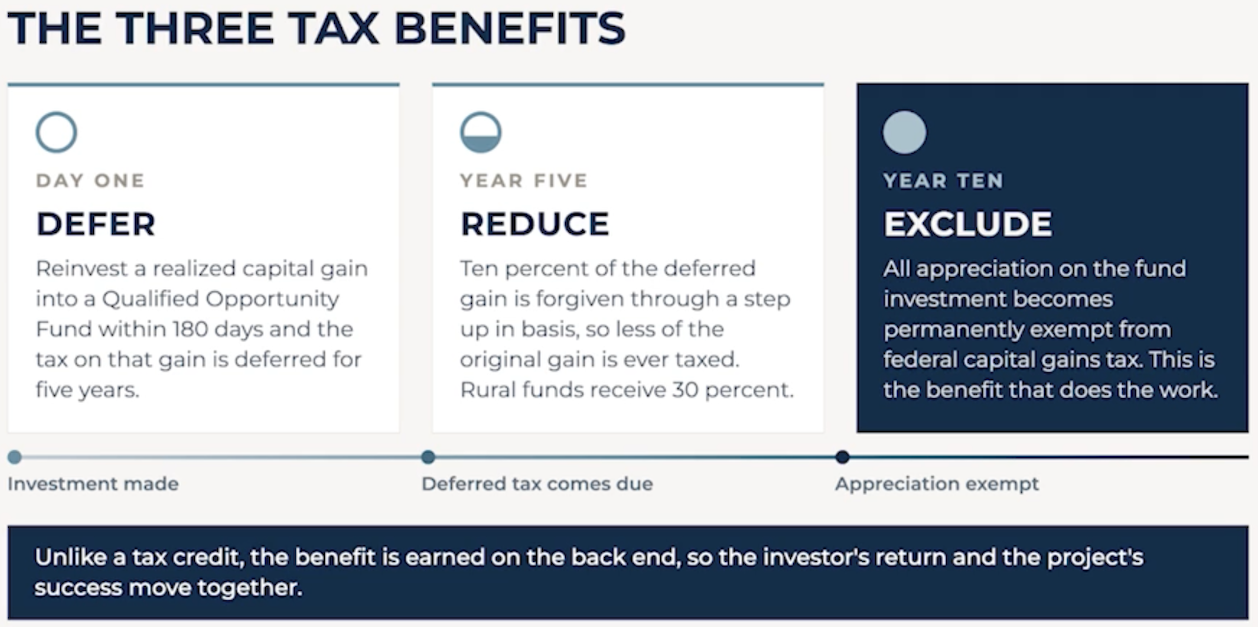
So the core benefits are:
- Tax Deferral: Investors can sell appreciated assets (such as stocks, businesses, or real estate) and reinvest those capital gains into a QOF. This allows for the deferral of the original tax liability.
- Potential Basis Step-Up: Under current regulations, QOF investors who hold their investment for at least five years may receive a 10% basis step-up on the deferred gain. Investments in funds that place at least 90% of their assets in rural QOZ property may qualify for a 30% step-up.
- Tax-Free Growth: The primary incentive for long-term investors is the potential for tax-free growth. If an investor holds their interest in the fund for at least 10 years, their basis is typically stepped up to fair market value upon exit, effectively eliminating capital gains liability on the appreciation generated within the fund. Many of these investments are designed to produce income after year 3, which is taxed, but does provided liquidity before a total 10 year lock up.
It's important to note the potential downside to these investments as well:
- Long-Term Horizon: QOZ investments are generally considered long-term, illiquid holdings. Returns of capital and the realization of tax benefits typically occur only upon partial or complete disposition or refinancing of the underlying assets.
- Speculative Nature: These funds are often newly formed entities without operating histories. They carry risks associated with real estate development, including property value fluctuations, potential for foreclosure, and regulatory changes.
- Complexity: The rules governing QOZs (under Sections 1400Z-1 and 1400Z-2 of the Internal Revenue Code) are subject to ongoing IRS review and guidance. Tax benefits are not guaranteed and may be affected by state laws, which sometimes have their own requirements separate from federal rules.
Looking Ahead
We remain committed to a disciplined approach that balances growth, protection, and tax-efficiency. As always, your portfolio is monitored with an eye toward your specific financial objectives. If you would like to discuss how these recent market developments may impact your personal financial plan, or if you have questions regarding your current allocation, please do not hesitate to reach out.
Happy trails,
Stephen Heitzmann, MSF, CPWA®, CRPC®
Managing Partner, CEO
Bauer Heitzmann
Disclaimer: Any recommendation contained in this update may not be suitable for all investors. Neither the information nor any opinion expressed herein constitutes an offer or a solicitation of an offer to buy or sell securities. Bauer Wealth Management reviews and archives outgoing and incoming e-mail.

.png)
.jpg)
.png)